Easy Language
Here you can find our information in easy-to-read English
You can find this information in easy-to-read English here:
-
What is the German Environmental Specimen Bank?
-
What does the Environmental Specimen Bank do?
-
What information can you find on this website?
-
What can you do on this website?
-
How accessible is this website?
What is the German Environmental Specimen Bank?
The short term is: ESB.
A bank is another word for a collection.
For example, we collect blood donations in a blood bank.
A specimen is another word for sample.
For example, we study different specimens of mussels.
We collect samples from the German environment.
We also collect samples from people in 4 locations.
We can then see:
How is the environment in Germany doing?
And how are the people in Germany doing?
What does the Environmental Specimen Bank do?
Every year, we collect a lot of samples.
For example:
-
fish
-
leaves from trees
-
blood of people
We test the samples.
This is what we find out:
Are there any bad things in the samples?
One example is lead.
Lead is a toxic metal.
The environment and people can both get sick from lead.
We also store samples.
We keep the samples very cold.
This stops the samples from going bad.
Then we can still test the samples in the future.
What information can you find on this website?
On this website, you can find information about:
-
What does the Environmental Specimen Bank do?
-
What are the results of the work of the Environmental Specimen Bank?
The website has 7 main parts:
-
Home
-
Basics
-
Profiles
-
Data search
-
Results
-
Service
-
Glossary
Here, you can read more about the 7 main parts:
Home
This page is the home page.
Here you can find the latest news on these things:
-
What does the Environmental Specimen Bank do?
-
What does the Environmental Specimen Bank find out?
Basics
Here we look at the Environmental Specimen Bank.
The Environmental Specimen Bank has been around
for more than 30 years.
Profiles
You can find information about the samples here.
For example:
information about fish and trees.
Data search
Here you can look for things on your own:
What things did we find out when we did the tests?
This can be tricky.
That’s why there are some steps to help you.
Note: The information is not in easy-to-read English.
Results
Here is what we learned when we did our tests.
You can also find reports and other texts
from the Environmental Specimen Bank.
Note: The results and the texts are not in easy-to-read English.
Service
When you click Contact
you will find our email address.
You can send us an email.
We will answer as soon as we can.
When you click Help
you will find lots more information about our website.
Note: This information is not in easy-to-read English.
Glossary
The glossary contains difficult words.
We explain what the difficult words mean.
This will help more people to understand the information on our website.
How do you use this website?
You will see the logo of the Environmental Specimen Bank in the top left corner of the website.

Clicking on the logo
always takes you back to the home page.
The website has seven parts.
You can see them to the right of the logo

Is the name of the part inside the blue box?
Then that is the part where you are right now.
Some parts have extra things to read about.
Move the mouse over a part of the website.
Then you can see the other topics in this part.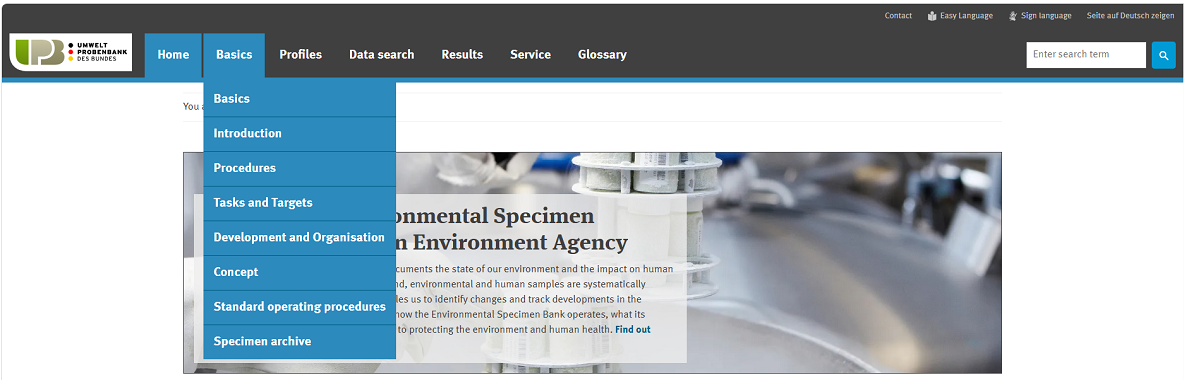
Would you like to know more about a part of the website
or extra information?
Then click on that part or information.
Look in the top right corner.
You will see 4 buttons there:

-
Contact
You can find our email address here.
-
Easy language
Here you can find information in easy-to-read English.
This is where you are right now.
-
Sign language
Here you can find information in sign language.
-
Seite auf Deutsch zeigen
This is German and means:
If you click here, the whole website will be shown in German.
There is a search box below that.

You can use this box to search for one word or more words on the website.
Write the word or words in the white box.
Click the blue box with the magnifying glass.
Or press the Enter key on your keyboard.
The website has a blue box at the bottom.

Here you can also find the seven parts of this website.
You see these buttons below the blue box:

-
Imprint
The imprint tells you:
Who made this website?
-
Contact
You can find our email address here.
-
Privacy
This tells you:
How do we protect your data?
-
Accessibility Statement
This tells you:
How accessible is this website?
-
To top
Click here to return to the top of the website.
You see 6 buttons for social media at the bottom of the page:

-
Facebook
The button for Facebook is this letter: f
-
Youtube
The button for Youtube is a box with a triangle.
-
Instagram
The button for Instagram is a box with a circle.
-
LinkedIn
The button for LinkedIn are these letters: in
-
Mastodon
The button for Mastodon is this letter: m
-
Bluesky
The button for Bluesky is a butterfly.
You click on a button?
Then our social media page opens up.
How accessible is this website?
Websites should be as accessible as possible.
That means:
Everyone should be able to use the website easily.
There are rules for all websites.
Websites must follow the rules.
They also apply to this website:
These rules are written down in the following laws:
-
German Disability Equality Act
-
Barrier-Free Information Technology Ordinance
In November 2025 and March 2026, we checked to see:
How accessible is this website?
The result is:
This website is not yet accessible.
For example, these things are not yet accessible:
-
We have informative pictures on our website.
When you make our website bigger
you can no longer see the informative pictures well.
-
We have maps on our website.
You cannot navigate the maps with a keyboard.
-
Some pictures have no alternative text.
Alternative texts describe:
What can you see in the picture?
-
Sometimes the colours are too similar.
The result is for example:
It is difficult to read a text.
-
You cannot easily use some parts of the website with a screen reader.
Blind people cannot use these parts of the website well.
A screen reader reads out the website.
-
Some PDF documents are not accessible.
You can find more information
in the Accessibility statement in standard language.
Report barriers
Are you having problems with this website?
Is there something on this website that you cannot use?
Please let us know.
You can send us an email.
The email address is:
upb@uba.de
Or you can send us a letter.
The address is:
Umweltbundesamt
P.O. Box 1406
D-06813 Dessau-Rosslau
Arbitration process
The arbitration process helps you to solve problems with us.
Have you contacted us?
Have you not gotten a reply?
Or are you not satisfied with the answer?
Then you can contact the arbitration service.
You can also do this in easy-to-read language.
And you can do this in sign language.
The arbitration process costs nothing.
You do not need a lawyer.
Lawyers are people who know about the law
and can give you advice or help you with legal problems.
The address is:
Arbitration Service pursuant
to the German Act on Equal Opportunities for Persons with Disabilities
to the Federal Government Commissioner
for Matters relating to Persons with Disabilities
Mauer-Strasse 53
10117 Berlin
The telephone number is:
+49 30 18 52 72 80 5
The email address is:
info@schlichtungsstelle-bgg.de
The web address is:
https://www.schlichtungsstelle-bgg.de/Webs/SchliBGG/EN/home/english-node.html
The accessibility statement in standard language
is dated 8 February 2022.
We updated our accessibility statement
on 10 April 2026.