Analysis of 18 mercapturic acids in urine samples from the German Environmental Specimen Bank — tackling the data gap in the human biomonitoring of VOCs in Europe
Pluym, Nikola; Burkhardt, Therese; Weber, Till; Scherer, Gerhard; Scherer, Max; Kolossa-Gehring, Marike
Journal of Exposure Science & Environmental Epidemiology
BACKGROUND: Human biomonitoring (HBM) plays a pivotal role in assessing exposure to toxicologically relevant chemicals, with urinary metabolites serving as key indicators. Despite the widespread implementation of HBM programs globally, certain metabolites, such as mercapturic acids (MAs) derived from volatile organic compounds (VOCs), remain understudied in nonoccupationally exposed populations.
OBJECTIVE: To bridge this data gap, we analyzed 18 MAs in 360 24-h urine samples collected over a time span of 21 years from 2000 to 2021 in Germany.
METHODS: Two LC-MS/MS methods were utilized to quantify MAs in urine samples obtained from the Environmental Specimen Bank. Statistical analyses, including Kruskal-Wallis tests and Spearman correlations, were employed to evaluate temporal trends, sex-specific differences, and correlations between MAs.
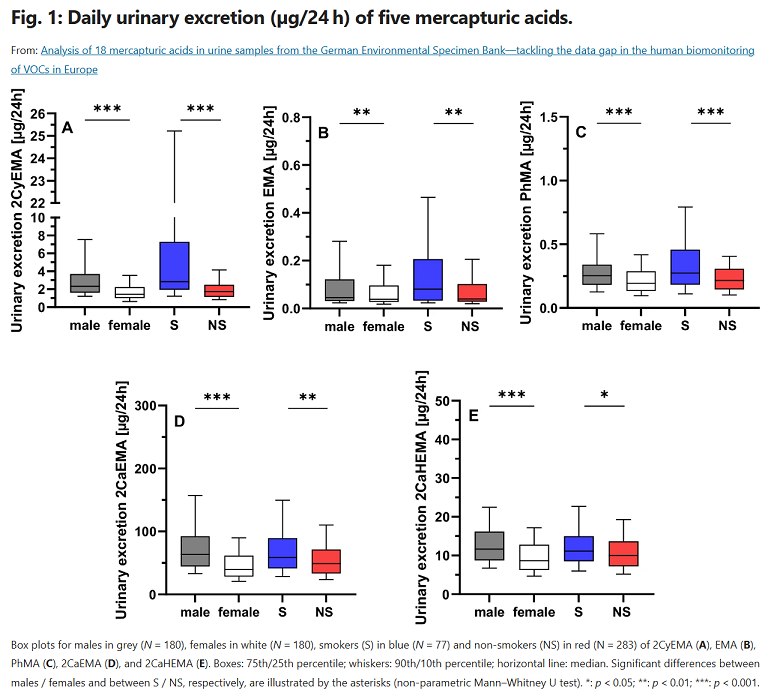
RESULTS: Quantification rates between 95 and 100% were obtained for 14 of the 18 MAs, with notable variations in concentrations among different metabolites. The most pronounced decrease in MA levels was observed from 2010/2015 to 2019 with a significant trend for 8 MAs, potentially reflecting changes in environmental exposures and regulations. Moreover, significant differences in urinary excretion per 24 h between males and females were observed for several MAs, highlighting the importance of considering sex in exposure assessments.
IMPACT STATEMENT: Comprehensive human biomonitoring (HBM) data with regard to the exposure to volatile organic compounds (VOCs) in Europe is lacking. This prompted us to quantify 18 mercapturic acids as urinary VOC metabolites in 360 samples from the Environmental Specimen Bank collected between 2000 and 2021 in Germany. Our study demonstrates the ubiquitous exposure to numerous VOCs of high toxicological relevance, albeit with a decreasing trend over time for most of the metabolites. This emphasizes the need for a broader HBM to better understand the risk of VOC exposure in Germany and more general in Europe.
doi.org/10.1038/s41370-026-00838-x