Synthetic pyrethroids in European surface waters: sources, occurrence and need to reduce contamination
Hitzfeld, Kristina L; Aldrich, Annette; Barth, Sofia N; Buijs, Simon; Duffek, Anja; Duquesne, Sabine; Ganz, Vera; Hein, Arne; Hillebrand, Marcus; Holmes, Breanne E.; Koschorreck, Jan; Lahr, Joost; Meier, Christiane; von der Ohe, Peter C.; Schaffer, Mario; Smit, Els; Ziegler, Korinna; Weisner, Oliver
Springer Nature
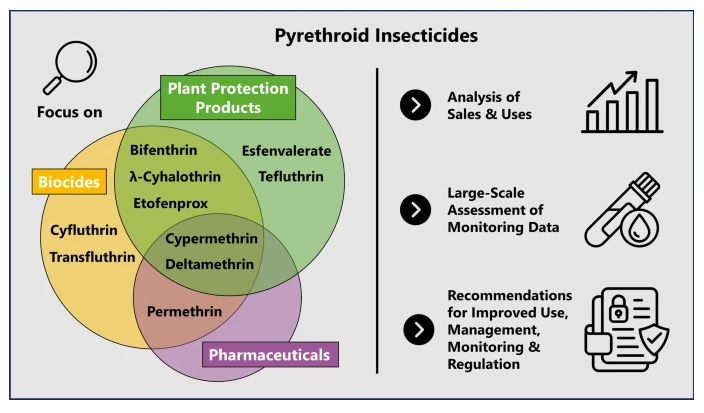
Pyrethroids represent a class of highly potent insecticides characterised by their widespread use, extreme toxicity to non-target aquatic organisms, complex regulatory status, and the unique challenges they pose for environmental monitoring and risk assessment. With cypermethrin already listed as a priority substance under the Water Framework Directive (WFD), and four additional pyrethroids now designated as such, this review aims to raise awareness of key issues related to the regulation, use, and monitoring of pyrethroids in order to reduce the contamination of surface waters. For this purpose, we evaluated measured pyrethroid concentrations in surface waters from different selected monitoring programs in Europe, and derived suggestions for environmental quality standards (EQS) where these were unavailable. Our analysis shows that the current analytical methods are still largely inadequate, as in most European countries the limits of quantification (LOQ) are too high to reliably assess compliance with EQS for pyrethroids. Where concentrations could be quantified with a sufficiently low LOQ, exceedances of the respective EQS were frequently observed, thus supporting the proposed inclusion of bifenthrin, deltamethrin, esfenvalerate, and permethrin on the list of priority substances under the WFD.
Moreover, our analysis reveals that monitoring limitations prevent evaluations whether other pyrethroids, such as cyfluthrin, λ-cyhalothrin, etofenprox, tefluthrin, and transfluthrin, pose similar threats to surface water quality. In order to meet WFD surface water quality goals while maintaining the availability of pyrethroid insecticides, urgent and coordinated action is needed by all stakeholders involved in their regulation, use and monitoring. We recommend the following key measures: (i) reducing the use of pyrethroids and emissions to surface waters, (ii) investing in improved routine analytical capability, and (iii) harmonising pyrethroid regulations as well as promptly integration of new knowledge.
doi.org/10.1186/s12302-025-01249-9
Graphical Abstract