Use cases from the German NTSPortal on the systematic use of high-resolution mass spectrometry non-target screening data in environmental monitoring and chemicals management
Kronsbein, Anna Lena; Wallis, Ronya Mona; Winter, Eric; Bandow, Nicole; Jewell, Kevin S; Dierkes, Georg; Wick, Arne; Koschorreck, Jan
Springer Nature
Abstract
Background
Society aims for a pollutant-free environment, reflected in initiatives under the European Green Deal, which seek to reduce hazardous substances and promote safe, sustainable chemical use. Comprehensive exposure data are needed to identify sources, understand mixtures and eliminate sources of chemical pollution. High-resolution mass spectrometry non-target screening (HRMS NTS) is increasingly used in environmental regulatory context to chemically characterise the environment as completely as possible and retrospectively screen for known and emerging substances.
Results
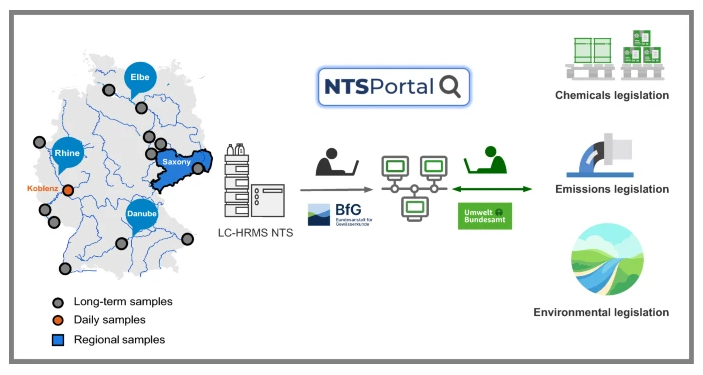
This study provides use cases for monitoring and chemicals management with data from the German NTSPortal, a database and visualisation tool for HRMS NTS data from surface water and suspended particulate matter of major German rivers. Its internal spectral library enables substance identification comparable to standardised target analysis, supporting regulatory acceptance of HRMS NTS data for prioritisation and mixture assessment. To demonstrate its potential to research and regulation, we characterised the spatial and temporal distribution of riverine chemical mixtures and present selected use cases relevant to EU environmental, emission, and chemical legislation. Despite pronounced spatial variability, mixture composition based on presence–absence data remained stable over time, with 855 of 1721 substances detected at least once and 247 occurring ubiquitously. Declining trends for regulated substances such as carbendazim and climbazole illustrate the effectiveness of regulatory measures. Overall, the results showed that NTS data repositories can help overcome fragmented exposure information and enable more consistent use of monitoring data across policy areas, including evaluation of the revised Urban Waste Water Treatment Directive and One Health concepts.
Conclusions
Data from the German NTSPortal enabled a multi-matrix and temporal characterisation of riverine chemical mixtures, revealing both stable mixture compositions over time and persistent, catchment-specific substances. These data facilitated high-resolution mixture assessments across space and time, alongside trend analyses that meet regulatory needs in environmental monitoring and chemical risk assessment. Further temporal, spatial, chemical and matrix-spanning expansion of HRMS NTS repositories will enhance their value for environmental monitoring programmes. Strengthening interoperability, implementing FAIR data principles, and developing advanced tools for prioritisation, quantification and toxicity prediction, including AI-based approaches, will be crucial to fully realise the regulatory potential of NTS portals in the future.
doi.org/10.1186/s12302-026-01368-x
Graphical abstract