Assessing the chemical burden of the North-East Atlantic ecosystem through targeted and untargeted HRMS-based approaches
Gkotsis , Georgio; Nika, Maria-Christina; Nikiforos; Vasilatos, Konstantinos; Athanasopoulou, Antonia; Barber, Jonathan L.; Berbee, Rob; Burgeot, Thierry; Galante Oliveira, Susana; Gustafsson, Johan; Iglesias Campos, Alejandro; Kammann, Ulrike; Kirchgeorg, Torben; Koschorreck, Jan; Mauffret, Aourell; Mil-Homens, Mário; Mørk Larsen, Martin; Munch Chistensen, Anne; Näslund, Johan; Oswald, Peter; Øystein Hjermann, Dag; Parmentier, Koen; Pirntke, Ulrike; Power, Andrew; Soerensen, Anne L.; Van der Stap, Irene; Viñas, Lucia; von der Ohe, Peter; Webster, Lynda; Wilson, Simon; Slobodnik, Jaroslav; Thomaidis, Nikolaos S.; McHugh, Brendan
Journal of Hazardous Materials
Highlights
-
Extensive HRMS-based monitoring in marine samples from the North-East Atlantic Ocean.
-
Wide-scope target screening revealed the presence of 132 organic pollutants.
-
Additional substances were identified and semi-quantified through suspect screening.
-
Prioritization of chemicals was performed to support pollution policy initiatives.
-
The prioritization list included legacy (PAHs, PFAS and PCBs) and emerging chemicals.
Abstract
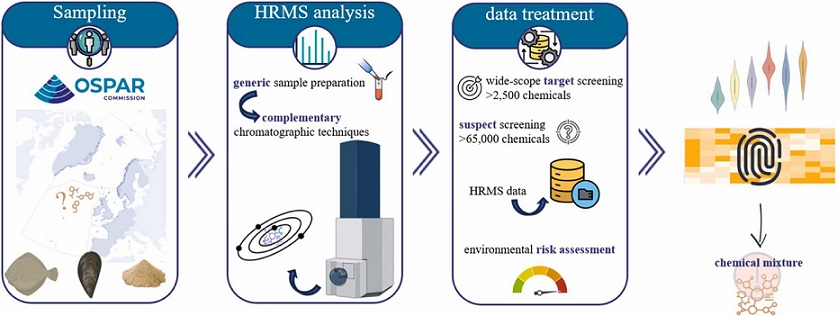
Human activities have introduced significant amounts of anthropogenic chemicals into marine ecosystems, posing threats to aquatic biodiversity and human health. Although, traditional marine monitoring focus primarily on legacy pollutants, the presence and potential risks associated with complex emerging chemical mixtures should not be neglected. In the context of the present study organized via OSPAR Commission and supported by NORMAN network, 52 marine samples were gathered from North-East Atlantic Ocean. State-of-the-art HRMS-based analytical workflows were employed to identify their chemical fingerprint. 132 organic pollutants were identified through wide-scope target screening of more than 2,400 environmentally relevant organic pollutants. The HRMS data were digitally stored in NORMAN DSFP and 134 additional chemicals were tentatively identified through suspect screening of more than 65,000 chemicals. The list included legacy pollutants, along with emerging pollutants, their metabolites and transformation products. A simplified environmental risk assessment was conducted, aiming to prioritize substances based on their potential risks to the marine ecosystem.
This study provides a valuable snapshot of the marine pollution, offering insights into chemical occurrence and risks. The findings can support marine scientists, environmental managers and policymakers in identifying pollutant sources, understanding their impacts, and informing regulatory measures to mitigate threats to marine ecosystems.
doi.org/10.1016/j.jhazmat.2025.138393
Graphical Abstract